 By
Advertising: This article contains affiliate links to Amazon, marked with a yellow underline. As an Amazon Associate I earn from qualifying purchases. However, the price remains unchanged for you. Thanks to the revenue, ShapeGanic is available to you at no cost.
Among lifters, intermittent fasting has a reputation as a tool for cutting, not for building muscle. If you only eat for eight hours a day, getting enough protein seems hard, and many people worry about losing muscle. Studies in trained men and women paint a more nuanced picture: with resistance training and enough protein, lean mass was maintained or even increased on a 16:8 schedule, and body fat dropped slightly more than on a normal diet. What fasting did not do in any of these studies was add extra muscle.
This article covers what the research on intermittent fasting and weight lifting shows, how much protein an eight-hour eating window needs, and when to train. We also look at the best-known fasting protocols for lifters: Leangains, the Renegade Diet, and the Warrior Diet. Because protein is the bottleneck in a short eating window, many lifters round out their meals with whey protein. Whey protein provides protein, and protein contributes to a growth in muscle mass.
Can You Build Muscle While Intermittent Fasting?
The broadest evidence comes from a 2024 meta-analysis of 15 randomized trials with 361 adults who exercised regularly. Compared with a normal diet, eating only within a six- to twelve-hour window led to an average loss of 3.9 pounds of body weight and 2.7 pounds of fat mass. Lean mass and physical performance did not differ between the groups. In other words, the eating window cost the participants no muscle, but it did not add any either.
Two trials show in more detail what this means for lifters. In a study of 34 resistance-trained men, one group ate only between 1 p.m. and 8 p.m. for eight weeks, with meals at 1, 4, and 8 p.m., while the comparison group ate at 8 a.m., 1 p.m., and 8 p.m. Both followed the same training program. Fat mass dropped in the time-restricted group, while lean mass, arm and thigh muscle area, and maximal strength were maintained in both groups. However, the fasting group ate about 180 fewer calories a day, and their testosterone and IGF-1 levels decreased.
A study of 40 resistance-trained women went a step further. Everyone completed eight weeks of supervised resistance training; two groups ate only between noon and 8 p.m., one group without a time limit. Calories and protein were the same in all groups, at 1.6 grams of protein per kilogram of body weight, or about 0.73 grams per pound. Lean mass increased by 2 to 3 percent in every group, and muscle growth and strength gains did not differ. So building muscle with an eight-hour eating window is possible, as long as training and protein are in place.
| Study | Participants | Eating window | Result |
|---|---|---|---|
| Meta-analysis, 2024 | 361 regularly exercising adults in 15 trials | 6 to 12 hours | 2.7 lb less fat mass, lean mass unchanged |
| Trained men, 2016 | 34 lifters, 8 weeks | 1 p.m. to 8 p.m. | Fat mass fell, muscle and strength maintained |
| Trained women, 2019 | 40 female lifters, 8 weeks | Noon to 8 p.m. | 2 to 3% more lean mass, same as without a window |
| TREAT trial, 2020 | 116 adults with overweight, 12 weeks, no resistance training | Noon to 8 p.m. | No weight-loss advantage, more lean mass lost in arms and legs |
How fast results show up is hard to say from these studies, since they lasted only eight to twelve weeks. Long-term trials in lifters are lacking, as are studies designed specifically for maximum muscle gain in a calorie surplus.
Does Intermittent Fasting Cause Muscle Loss?
The concern is not unfounded, but it mainly applies to people who fast without lifting. In the TREAT trial, 116 adults with overweight ate only between noon and 8 p.m. for twelve weeks, while a comparison group ate three set meals a day. The eating window produced no additional weight loss. Among participants whose body composition was measured, however, the time-restricted group lost more lean mass in their arms and legs than the comparison group. Resistance training was not part of the study, and participants ate as much as they wanted within the window.
A 2021 review explains why a short eating window can matter for muscle. Without food, muscle protein breakdown outpaces synthesis, and only a protein-containing meal switches synthesis back on. After a few hours, the response fades, and it takes roughly three to five hours before it can be fully stimulated again. Someone eating two meals therefore uses fewer of these windows than someone eating four. The authors consider intermittent fasting a suboptimal strategy if the goal is maximum muscle, but they acknowledge that their view rests mainly on short-term lab studies and that long-term data are missing.
In practice, that means: if you fast, keep lifting and spread your protein across several meals within your eating window.
How Much Protein Do You Need in Your Eating Window?
A review of protein distribution sets a target for lifters of at least 1.6 grams of protein per kilogram of body weight per day from all foods, or about 0.73 grams per pound, spread over at least four meals of 0.4 grams per kilogram (about 0.18 grams per pound) each. At the upper intake of 2.2 grams per kilogram (about 1 gram per pound) reported in the literature, that works out to no more than 0.55 grams per kilogram (0.25 grams per pound) per meal. Four meals fit into an eight-hour window, for example at noon, 2:30, 5:00, and 7:30 p.m. If you keep the three to five hours between meals suggested by the 2021 review, three larger meals are more realistic.
A 2023 study shows that large servings are not wasted: after exercise, the anabolic response to 100 grams of protein lasted more than twelve hours, longer than with 25 grams, and amino acid oxidation barely increased. Whether two large meals build as much muscle over time as four smaller ones has not been studied, though.
| Body weight | Protein per day (0.73 to 1 g/lb) | Per meal, four meals | Per meal, three meals |
|---|---|---|---|
| 130 lb | 94 to 130 g | 24 to 32 g | 31 to 43 g |
| 150 lb | 109 to 150 g | 27 to 37 g | 36 to 50 g |
| 170 lb | 123 to 170 g | 31 to 42 g | 41 to 57 g |
| 190 lb | 138 to 190 g | 34 to 47 g | 46 to 63 g |
| 210 lb | 152 to 210 g | 38 to 52 g | 51 to 70 g |
| 230 lb | 167 to 230 g | 42 to 57 g | 56 to 77 g |
The easiest way to hit these amounts is to include a protein source in every meal, such as meat, fish, eggs, Greek yogurt, cottage cheese, or beans. If that isn’t enough, a scoop of whey protein with 20 to 25 grams of protein, depending on the product, can round out your post-workout meal. A protein shake breaks your fast because it contains calories, so it belongs inside your eating window. For the last meal before the fast, some lifters choose casein, which is digested more slowly than whey; protein contributes to the maintenance of muscle mass.
Should You Lift Weights Fasted?
Whether you train fasted or after your first meal is mostly a question of your schedule. A meta-analysis of 46 studies found that eating before exercise improved performance only in longer endurance exercise, not in shorter bouts. There is far less data on fasted weight training, and we found no studies comparing fasted and fed lifting within an intermittent fasting schedule.
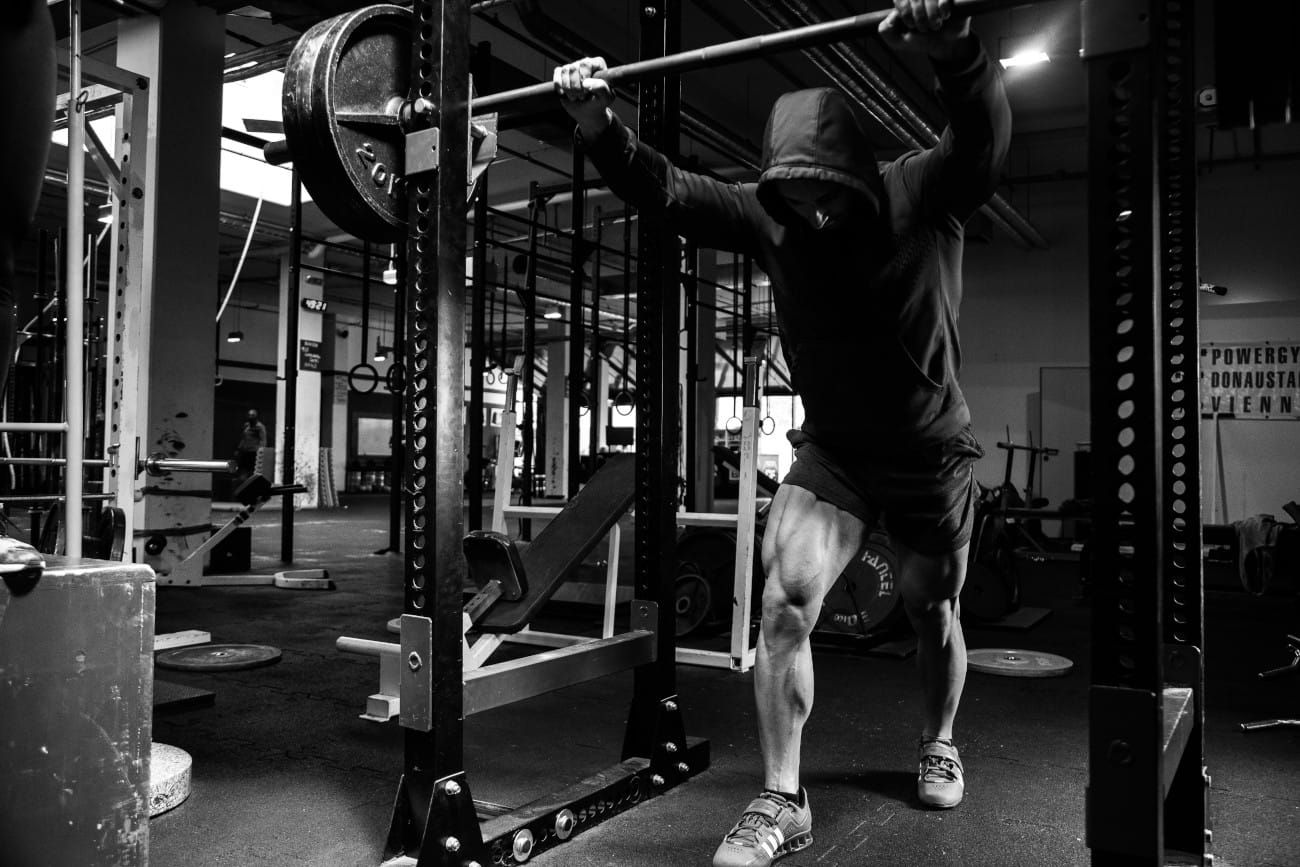 Photo by Alexander Red on Unsplash
The simplest option is a late-afternoon or early-evening workout: it falls inside your eating window, and your biggest meal follows right after. If you lift in the morning before work, you can move your window earlier, for example to 9 a.m. to 5 p.m., so your first meal comes right after training. The Leangains protocol calls for 10 grams of branched-chain amino acids (BCAAs) before a fasted workout. That isn’t necessary as long as your daily protein intake is adequate, as our BCAA guide explains.
Many lifters take creatine with a meal in their eating window. Creatine increases physical performance in successive bursts of short-term, high intensity exercise; the beneficial effect is obtained with a daily intake of 3 grams. Our guide to taking creatine covers dosage and timing in detail.
Leangains vs. Renegade Diet vs. Warrior Diet
There are three well-known fasting protocols for lifters. All three come from coaches and authors rather than researchers, and none has been tested in a controlled trial of its own. The table shows how they differ.
| Protocol | Fasting and eating | Training | Carbs | Evidence |
|---|---|---|---|---|
| Leangains | Fast overnight and through the morning, then 8 hours of eating | Often fasted after 10 g BCAAs, followed by the biggest meal | More on training days, more fat on rest days | No trial of its own; closest to the 16:8 pattern in studies |
| Renegade Diet | 12 to 16 hours of fasting, then one or two small meals | After the small meals | Only after training, then plenty | No trial of its own; no proven benefit of evening carbs |
| Warrior Diet | 20 hours with small snacks, then a 4-hour feast | Usually shortly before the eating window | In the evening | Studies with a four-hour window; protein hard to spread out |
Leangains goes back to Swedish coach Martin Berkhan. In his 2010 guide, the fast runs through the night and the morning, and the eight-hour eating window begins with the post-workout meal. Training is done on an empty stomach after 10 grams of BCAAs, and most of the day’s calories come afterward. Training days get more carbs, rest days more fat, and protein stays high every day. The study in trained men, with its 1 p.m. to 8 p.m. window, comes closest to this pattern.
The Renegade Diet comes from American strength coach Jason Ferruggia and is marketed with the promise of losing fat and building muscle at the same time. According to a description by Breaking Muscle, you fast for 12 to 16 hours, eat one or two small meals of vegetables, protein, and fat before training, and save your carbs for after training, such as white rice, sweet potatoes, and potatoes.
We found no study in lifters showing that carbs eaten in the evening fuel muscle better or burn more fat than the same amount spread across the day. The promise of losing fat while building muscle, on the other hand, isn’t unrealistic: the trained women gained lean mass, and among those who completed the program, fat mass dropped at the same time. But that has little to do with the Renegade Diet’s rules; training, protein, and energy balance explain it better.
The Warrior Diet moves all eating into a four-hour window in the evening. For building muscle, it is the tightest setup, because the recommended amounts of protein are hard to spread across several meals.
 Photo by Icons8 Team on Unsplash
For most people, a flexible 16:8 window built around training is the simplest approach, and it doesn’t require strict rules about carbs. How 16:8 works for weight loss is covered in our guide to the best intermittent fasting schedule.
Sample Schedule: 16:8 With Evening Workouts
 Photo by Brooke Lark on Unsplash
Here is what a day could look like for a 180-pound lifter who trains at 5:30 p.m. The eating window runs from noon to 8 p.m., and at about 150 grams of protein, the day lands in the middle of the range in the table above.
| Time | Phase | Meal or activity | Protein |
|---|---|---|---|
| 7:00 AM | Fasting | Water, black coffee, or unsweetened tea | 0 g |
| 12:00 PM | Eating window | 3-egg omelet with vegetables, 2 slices of whole-wheat toast | About 30 g |
| 3:00 PM | Eating window | 6 oz chicken breast, 1/3 cup uncooked rice, salad with olive oil | About 40 g |
| 5:30 to 6:30 PM | Training | Weight training | – |
| 6:45 PM | Eating window | 1 scoop whey protein in 10 oz milk, 1 banana | About 33 g |
| 7:45 PM | Eating window | 7 oz salmon or lean beef, 10 oz potatoes, vegetables, plus 3 to 5 g creatine | About 45 g |
| 8:00 PM | Fasting | Eating window closes until noon the next day | – |
How many calories you need depends on your weight, activity, and goal. To build muscle, intake sits slightly above maintenance; when cutting, below it. Our guide shows how to calculate your calorie needs. Adjust the portions of rice, potatoes, and bread, not the protein.
Who Should (and Shouldn’t) Try Intermittent Fasting for Muscle Gain?
The Academy of Nutrition and Dietetics notes that intermittent fasting is not currently a recommended treatment for weight loss or any other health condition. It advises against it for people with diabetes, women who are pregnant or breastfeeding, and anyone with a history of eating disorders, and it recommends talking to a doctor first, especially if you take medications.
| Situation | Good fit? | Why |
|---|---|---|
| Cutting phase with weight training | Yes | Studies show less fat mass with muscle maintained |
| Building muscle with a good appetite | Yes | Protein and calories fit into eight hours |
| Small appetite, struggling to eat a surplus | Probably not | The short window makes extra calories harder |
| Two training sessions a day | Probably not | Meals around both sessions barely fit into the window |
| Diabetes | No | The Academy advises against it; medications may need adjusting |
| Pregnancy and breastfeeding | No | The Academy advises against it |
| History of eating disorders | No | The Academy advises against it |
Summary
Intermittent fasting and muscle gain are not mutually exclusive. In studies of trained men and women, muscle was maintained or grew on a 16:8 schedule just as it did without an eating window, and fat mass dropped slightly more. Fasting offers no unique advantage for building muscle, though, and without resistance training it can cost you muscle. What matters is consistent weight training, 0.73 to 1 gram of protein per pound of body weight spread over three to four meals, and a calorie intake that matches your goal.
Leangains and the Renegade Diet are variations of 16:8 fasting with their own rules for training and carbs, while the Warrior Diet narrows the window to four hours. None of these protocols has been tested scientifically on its own. For building muscle, an eight-hour window built around your workout is the most sensible framework.
If you can’t reach your protein target with meals, a scoop of whey protein can fill the gap; protein contributes to a growth in muscle mass. Supplements are no substitute for a varied and balanced diet and a healthy lifestyle.
 Photo by